
Under Grazer’s stewardship and Howard’s direction, The Grinch’s transition from page to screen was as inventive as it was seamless. Grazer’s respectful handling of the Dr. Seuss Enterprises’ property rendered him, in the estate’s eyes, a proven caretaker of the author’s work. So the decision to entrust the movie rights for The Cat in the Hat to the filmmaker—who had not only brought Seuss’ verse and fully-realized world to the screen, but managed to enlarge the author’s vision to fill the larger medium and create an international blockbuster in the process—was a simple one.
Grazer, who recalled reading the book as a child, comments, “Because we grew up with these books, and because they have such universal themes and the illustrations ignite such fantasy in your mind as a child—the aggregation of all those feelings—it leaves an indelible, positive memory. And so when I realized I had a chance to convert first The Grinch and then, The Cat in the Hat, into movies, I was willing to do anything to bring them to the screen.”
Mike Myers had a similarly nostalgic memory about the children’s classic and recalls, “My earliest memories of Dr. Seuss are the book mobile in Toronto, this traveling library, where we would check out his books. My mother was an actress in England, and she would read the books to me and other kids, who came by to listen because she was so good at it. My earliest memory of Dr. Seuss is The Cat in the Hat, which I loved—it’s my favorite book. I loved the illustrations, and my mom read it with a Liverpool accent. That may be why it’s my favorite book of all time.”
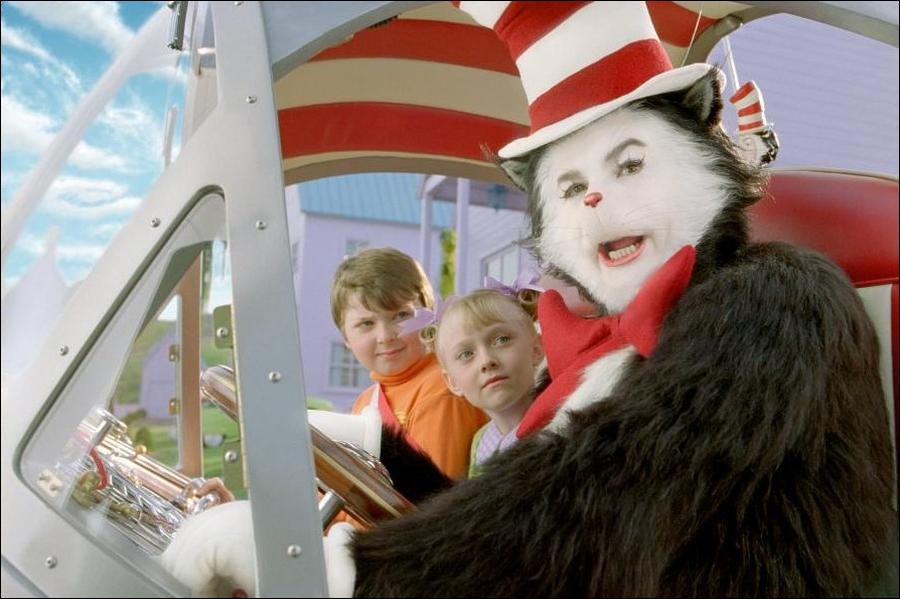
Myers notes that when Geisel wrote The Cat in the Hat in 1957, he was making a point about the proper way to have fun (responsibly!); upon review 45 years later, the book possibly has even more resonance today, with all of the high-tech distractions available to children in the 21st Century. For instance, it was one thing for a child of the 1950s to be grounded from watching television (with its limited choice of three networks), but if today’s child were forbidden from using computers, cable, video games and the like…
Grazer concurs and says, “The Cat basically comes along and shows these bored kids how to have fun without the usual distractions. He is there to show them the power is within you and you simply must appreciate it. And what he does is ignite excitement and joy within these kids for the things they have taken for granted and find passé. Ultimately, the Cat is an elegant anarchist, really.”
Grazer re-teamed the screenwriters from The Grinch (Alec Berg, David Mandel, Jeff Schaffer) and charged them to expand upon Seuss’ 1,620-word tome (give or take a super-hyphenated adjective or noun). His instructions were clear.
“The most critical aspect to making this movie is that you are paying homage to Dr. Seuss so—not to mix words here—we didn’t have the option to screw it up,” says Grazer. “Almost everyone has a memory of the book from their own childhood. And parents are still reading it with their children today.”
The filmmaker was mindful of the continuing popularity and the iconic stature of the Cat in the Hat. But by having the gifted Myers step into the paws of the fun-loving feline, he also saw an opportunity to bring the tale to a whole new generation of moviegoers, a good number of whom may (or may not) have read the book.
The expansion of the vocabulary-building Beginner Book into screenplay underway, it was decided that renowned production designer Bo Welch (recipient of four Academy Award nominations) would make his directorial debut on the project and helm the re-packaging of a second Seuss classic for the motion picture screen.
The challenges of transforming a two-dimensional, stylishly rendered property into a three-dimensional, eye-filling screen fantasy seemed a perfect fit for Welch—the creator of such magically transporting filmic worlds as Men in Black, The Lost Boys, Beetlejuice, Edward Scissorhands and others.
The first-time feature director felt the project was right up his alley, where he could exploit his expertise in art direction and allow it to inform him as a film director. Welch says, “To be able to translate The Cat in the Hat for the screen—it’s an invitation into a great world where you can let your imagination run wild and you are not restrained by physics. There’s just a silliness and a joy to it that we worked to capture in every aspect, from the acting to the design. Every aspect has to fit into Seuss’ immaculate universe.
Grazer notes, “Bo brings his considerable production design skills with him as a director, enabling him to not only oversee the creation of this amazing world of the Cat—a heightened reality and a palette of dazzling candy colors—but to add and orchestrate all of these great characters as well.”
“I see him as a visionary filmmaker with a kind of sensibility that’s a combination of Tim Burton and Barry Sonnenfeld,” adds Mike Myers. “He created a great atmosphere on the set. His camera work is brilliant, he’s a great storyteller and he creates an amazing universe in which to play—it was a pleasure to come to work. He has thought through every aspect of the story. And on top of it all, he genuinely laughs at the stuff I do—that’s great for a comedian, really inspiring.”
For his first movie, Welch had to deal with a variety of challenging elements, including children, animals, special makeup and visual effects. Says friend and Cat cinematographer Emmanuel Lubezki (who previously collaborated with Welch on The Birdcage and A Little Princess), “Bo handled it so beautifully it was like he had directed all his life.”
One of Alec Baldwin’s first movie roles was in Beetlejuice, which was designed by Welch. “I think it’s great for the movie business that Bo is directing because he is very clear on what he wants, yet is very easygoing and obviously his history proves that he is incredibly imaginative,” says Baldwin.
“What Bo has that all great directors have,” observes Kelly Preston, “is a great sense of cinematic timing. He knows just how to pace a scene, even down to a line, and in a comedy, timing is everything.”
Acknowledging that the Seuss books have linear narratives and that any subplots would need to be created, filmmakers were careful in taking the essence of the book and expanding the premise, increasing the scope of the tale to fill a motion picture and adding some characters in the spirit of Seuss. At its core, though, the story remains the same: two kids, Sally and Conrad, at home with seemingly nothing to do, are shown the marvels and risks of having fun by the titular talking feline.
In the hands of screenwriters, each child’s character is fleshed out and comes to represent opposite ends of a spectrum: Sally is orderly and task-oriented and her continual control mania has driven away her friends; Conrad is pure id, out to try anything on the path to fun, even if it means crashing through boundaries and rules set in place for safety’s sake.
Their mother (merely seen as a pair of legs at the ending of the book) is enlarged into a full maternal presence: real estate agent, single mother and neighborhood looker Joan Walden. Joan finds her time management skills seriously challenged by the conflicts of working for a demanding, persnickety boss (the newly created Mr. Humberfloob) and caring for two growing children, one of whom thinks nothing about destroying the kitchen in search of protective gear (a colander helmet, marshmallow bag and loaf of bread padding) for his latest adventure. Left with little choice and even less time, Joan, called back to the office prior to her party, opts to leave the kids with a babysitter, a large, dozy woman named Mrs. Kwan (also original to the screen version of the story).
Conrad’s unruliness is a point of commiseration between next-door neighbor Lawrence Quinn (a phony and malevolent presence sprung from the imagination of the filmmakers) and his mom. Quinn is a seemingly successful businessman and stand-in paternal figure for Joan’s children, using his proximity and wily charms to court his attractive neighbor. Underneath his smooth talk and glistening smile (ting!) lies a nearbankrupt, gold-digging lizard, out to snare Joan’s house and income and ship her son off to military school.
Another character lifted from Seuss’ tale is Conrad and Sally’s pet, a nervous fish that (upon the arrival of the Cat in the Hat) miraculously receives the power of speech— and uses it to repeatedly warn the children of the rules they are breaking, of the trouble they are causing, of the dangers inherent in having fun. Priding itself as the voice of reason, The Fish (also voiced with manic comic aplomb by Sean Hayes) nags and cajoles, finding myriad ways to say, “I told you so!”
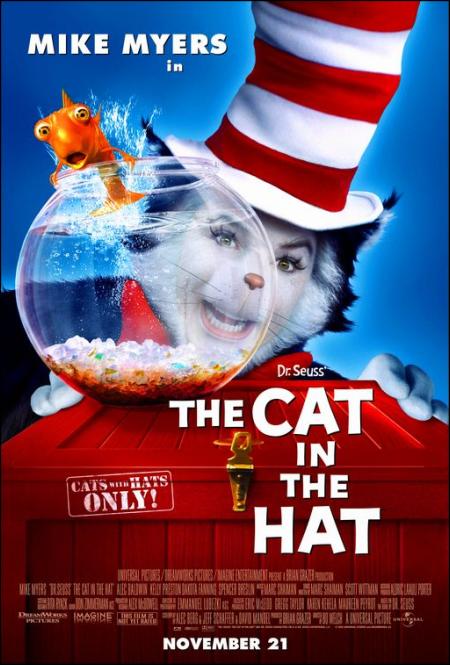
Dr. Seuss’ Cat in the Hat
Directed by: Bo Welch
Starring: Mike Myers, Kelly Preston, Dakota Fanning, Spencer Breslin, Alec Baldwin, Kath Soucie, Andrea Bowen
Screenplay by: Alec Berg, David Mandel, Jeff Schaffer
Sound Department: Andrea Toyias
Visual Effects by: Rif Dagher, Tom Lamb, Christopher Sjoholm. Jason Thielen
MPAA Rating: PG for mild crude humor, some double-entendres.
Studio: Universal Pictures
Release Date: November 21, 2003